
By MyNameStitch
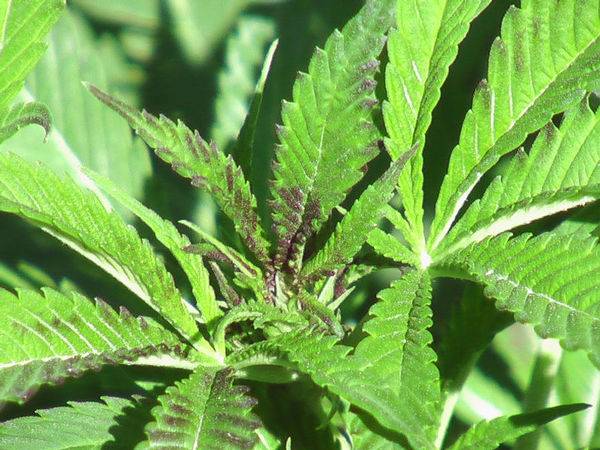
Phosphorus Lock Out Due to Cold Temps
Some varieties, like equatorial sativas, don't take well to cold weather. If you can keep the roots warmer, the plant will be able to take cooler temps than it otherwise could. Also note that in colder temps, phosphorus gets poorly absorbed and if this happens your plants can show purpling of the leaves and stems, (cannabis has a natural purple color to it's stems, the deep purple is what shows the problem)this is the same example when plants change color in flowering when environment triggers cause the plant to change color, also genes play a role as well.

This picture below shows phosphorus being locked out due to cold temps.
(Photo Credit: TikTok420)

Another lockout of phosphorus due to cooler temps
Light bleaching/ light burn
Only way to fix this is to Move the lights away from the plant!
Or make sure you dont go over 75 watts a sq foot, or your plant will have to much light and light bleaching can occur anywhere on the plant. (indica species seem to bleach easier than sativas imo.)
(Picture Provided by Boy Howdy)
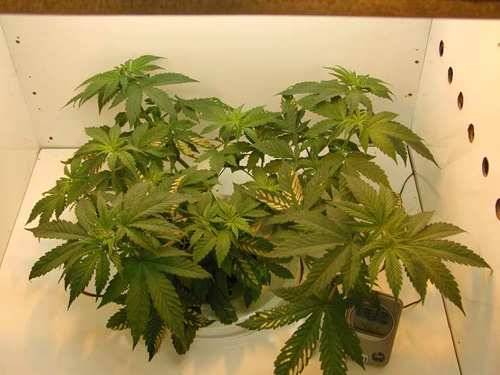
Heat Stress
Only way to fix this is to Move the lights away from the plant!
And get better ventalation, and or add more fans! Heat - If the lights are too close to the plant, the tops may be curled,
dry, and look burnt, mimicking a
nutrient problem. Your hand should not feel hot after a minute when you hold it at the top of the plants.
(Picture 1 and 2 Provided by Mosfed)
Nutrient Burn
Nutrient Burn is one of the MOST common mistakes a new grower makes, reason for this is, because a newer grower will use a chemical nutrient most of the time and listen to the directions on the box. This is a NO NO! Depending on the age of the plant, size, strain and soil mixture you are using also has a factor. There is no set guideline when using nutrients, but I can give you a good example to start out with so you will not burn your plants. It’s always good to start out light, rather than feed heavy. Remember you can always add more later, but can not take out when you added to much. Chemical and Organic nutrients differ. Chemical nutrients are more readily available and can burn way easier than organics can. Organics are easier for a newer grower to use, most of the time, and lessen your chances of burning your plants.
I recommend not using more than ½ teaspoon of chemical nutrients per gallon of water. Unless the plants are very big 5 feet+, then it’s safe to use 1 teaspoon per gallon of water. When your plants first emerge you want to wait at least 2 weeks before feeding your plants, unless your plants are in a soiless mixture, like pro mix. The cotyledons (its first set of round looking leaves) are what give the plant its food until they get the first 2 or 3 sets of leaves. If your plants are in a soiless mixture and are over the first week of age; you can feed a weak amount of nutrients, like ¼ teaspoon per gallon of water. Soiless mixtures are different from soil plants and soiless plants need to be fed more when using this mixture.
I also recommend not feeding more than 1 time a week if using ½ teaspoon per gallon of water for chemical nutrients. You can feed every other day,( this goes for chemical and organics) at very weak amounts, but doing this may contribute to over watering, and for that I do not recommend feeding more than once a week. Some people feed 2 times a week using like ¼ teaspoon per gallon of water.. Use 1/4 strength for first feeding and then go up to 1/2 strength from the 2nd feeding when using chemical nutrients. It’s very easy to overdo it. When using organics, depending on which one you’re using, I recommend using 1 teaspoon per gallon of water. When the plant gets bigger you can work your way up to using more nutrients when the plants get bigger.
As for soil mixtures, there are a lot of different kinds of soil’s out there. Using a rich soil mixture is not recommended for seedlings. Seedlings that are under 2 weeks of age you do not want to start them in rich soil, using a seed starter mixture is one of the safer ways. Seed starter mixtures are weak in nutrients, so it will not burn the seedlings but will provide them enough to get past seedling stage, but the downside is you have to transplant into a better soil mixture after 2 weeks of age. If you decide to start with this mixture, do not put your seedlings into a big pot. Start them out with using a cup or a small pot.
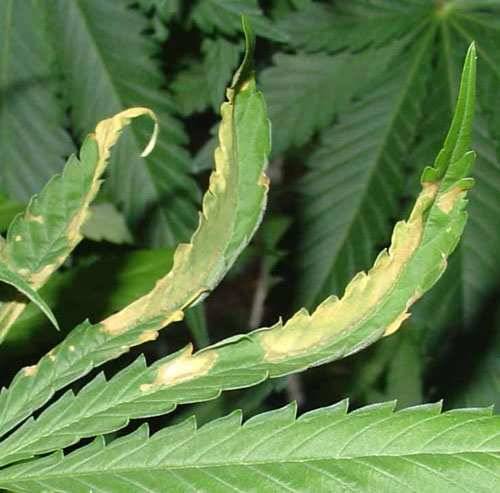
Nutrient Burn causes leaf tips to appear yellow or burnt. They can also be brown and twisted and crispy looking. Depending on the severity it can show many different symptoms and shows on lower part of the plant when its young, at older stages it can move anywhere on the plant.
To fix the problem when you have Nutrient burn, you want to flush out the plants with lots of water.
Soil
Soil should be flushed with lots of water, Use 3 gallons of water per one gallon of soil. Flush very thoroughly, after plant recovers usually after a week, you can resume using nutrients after a week or a week 1/2. When you flush your soil, you flush everything out, a lot of nutrients go with it, including the soil nutrients.
Hydro
Change out the reservoir, flush out any lines and clean out the entire system and replace with plain water for the first hour, then start out with lower parts per million (PPM)
Its good to clean out your system every 2 weeks and replace with fresh water and nutrients. Some people change everything every week!
Ahh, nute burn! Stop this by not adding to much chemical/organic nutrients to your water,foliar feeding. DONT feed more than 1 time a week unless using weak amount, use 1/4 strength for first feeding and then go up to 1/2 strength from then on when using chemical nutrients. Its very easy to overdo it. Causes leaf tips to appear yellow or burnt. NEVER give nutrients to plants that are under 2 weeks of age, at this age the soil nutrients are enough to suppliment them untill 2 weeks of age or more depending on how good your soil is. Using ferts before 2 weeks will almost likley kill your plants.
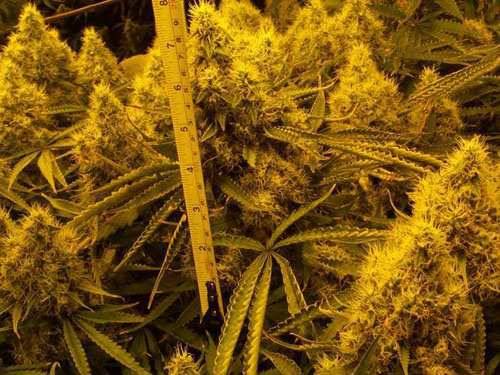
Pictures below show nutrient burn
(photo 1 credit: Hansi)
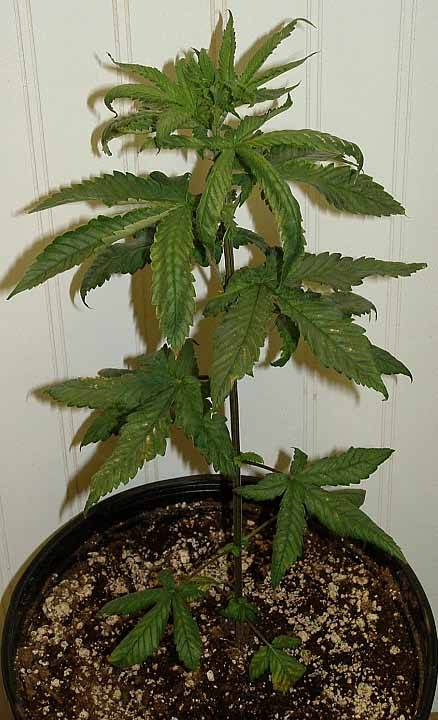
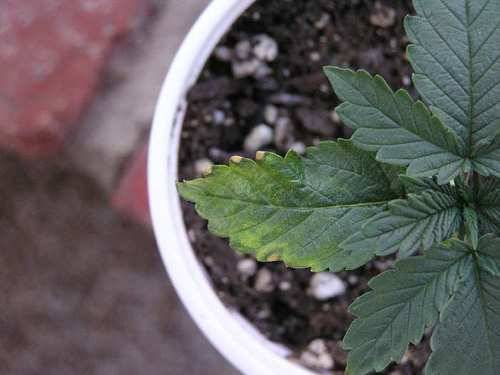
Picture 3 shows recovery of nutrient burn
(Photo Credit: The King Of New York)
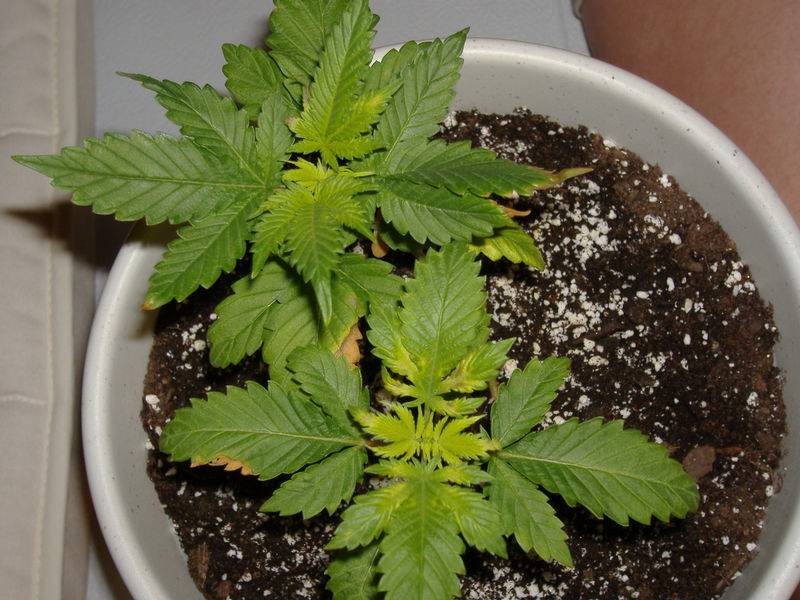
Stem Problems
Stem Breakage - Everyone from time to time has had this problem or will. This is when your stem is broken. Stem breaks can come from a number of things: training, dropping something on it, animals, weather. No matter how it happened the most important thing is to not panic.
Solution - Fixing this is not really a problem. Splint it with something and tape it in place. Marijuana has a great ability to come back even after a stem break. Give her a week or so to recover before she will start to grow again. And be more careful next time!
Misc things to know!!
When your humidity is low your leaves can become shriveled. Using humidity around 40-60% is fine for vegging and flowering.
If your plants are stretching than it can be caused by a few things. Not enough light, or it’s the wrong kind of light. Stay away from incadesant bulbs they produce more heat than good. Same goes for halogens, they are worthless and cause more heat than anything else. Instead get a HPS, MH, Fluros or some compact fluros!
Hps will keep your plant short and stubby while cool fluros will keep your plant bushy, while soft white will keep your plant tall,Having a mixture will have a tal and bushy plant! Nothing wrong with having mixed spectrums!
Or just go grow outside and save energy!!
Cloning Problems
A lot of times clones will yellow, when trying to root, some yellowing is alright, but if the yellowing is taking over and roots have not shown, you need to check to make sure the growing medium is close and tight to the stem. Allowing any air to get down into the hole will dry out the lower stem and can delay roots growing. Also making sure the medium is moist, but not saturated is important. Lighting does not have to be to close when they are un-rooted, after showing roots is when it’s important and the light needs to be closer.
Plain tap water that is ph adjusted is just fine till the clones have rooted. Giving any nutrients will kill them until they have been rooted, even then when giving clones nutrients for the first time needs to be a little bit weak.
If you are using a dome for cloning, you want to make sure if you do mist your plants, do not mist them heavily, you don’t want to spoil your plants, misting to heavy will delay rooting as well, you want your plants to grow roots to go get the water, they will root more slower if the water is readily given to them. Not to mention when you mist them a lot, your plants will have to be “weaned” from there dome. Your plants will droop quickly if taken out of the dome after they have been rooted. In order to stop this, do not mist them so much. If you are having problems with droopy clones, you may want to try an anti droop spray. This will help the plants stop drooping as bad. You can kill clones by not weaning them out of the dome or cause stress and stunt them. I have my own cloning method that stops the weaning process while using a dome, So remember don’t soil your clones by misting them daily, making sure your mediums you are using for cloning are moist enough to last through the cloning process, but not saturated. If the temperature in the medium where the roots are at is under 65 degrees, you'll want to use a heating mat. Temps of around 75 to 80 are optimal. Anything over 80F will cause transpiration and dry out your medium to quickly and roots will not have a chance of growing. Colder temps cause roots to slow causing yellowing in the leaves and stunting. Yellowing on the leaves of a clone is not always a sign of cold temperatures, there could be other problems like medium being too saturated, roots being delayed from cloning method, water temperatures being to warm if using a bubble cloner. Leaves that turn yellow on clone’s means it is using stored nutrients from the leaves to help it try to root. Clones that become cold before having a chance to root will less likely root at all.
Some strains are more difficult to clone than others, some can also root faster and some can take much longer. It seems indica dominant strains have a much easier time cloning, where sativa dominant strains are pickier and require “tweaking” your cloning method if you want to get a higher success rate.
Yellowing leaves on cuttings
When unrooted clones start to yellow it means they are either not touching the rooting medium good enough, to much co2. The vast majority of the time, an unrooted cutting will begin to yellow some of it's leaves, starting with it's largest oldest leaves, because it is too close to the lights and it needs to be moved farther away. Some yellowing is normal just as the cutting begins rooting and can be a sign of the cutting using it's oldest leaves as a food source while it is forming new roots. Plain tap water that is ph adjusted is just fine until the clones have rooted. Giving any ferts will kill them untill they have been rooted.
Seedlings Stretching
If your plants are stretching than it can be caused by a few things. Not enough light, Light not close enough, or it’s the wrong kind of light. Stay away from incandescent bulbs they produce more heat than good. Same goes for halogens; they are worthless and cause more heat than anything else. Instead get a HPS, (High Pressure Sodium) MH, (Metal-Halide) Florescent Tubes, or some compact florescent!
HPS will keep your plant short and stubby while cool florescent tubes and compact florescent (blue spectrum) and MH will keep your plant bushy, while soft white will keep your plant tall, having a mixture will have tall and bushy plants! Nothing wrong with having mixed spectrums!
Or if you can safely, just go grow outside and save energy!!
If you are running in hydro its good to change your water every 2 weeks TOPS to keep out bacteria growth and to keep your plants with a good supply of fresh water.
A good rule to go by for how much PPM each part of your plants growth has is as follows:
(This is just a guideline and in different situations the ppm would need to be changed)
Seedlings should be around 50-150 PPM
Unrooted clones to be around 100-350 PPM
small plants to be around 400-800 PPM
large plants to be around 900-1800 PPM
Last week of flowering use plain water.
If you see dark or patchy spots on your leaves, that could mean you have mold. Check fordark patchy areas on the leaves and if you do have mold, lower the humidity and get a better ventilation setup going to prevent further occurrences.
And most important.. KEEP YOUR GARDEN CLEAN!!!
PPM = parts per million
EC = electric conductivaty
TDS = total desolved solids
(information provided by syko2)
PPM--EC conversion Chart
Re-printed with Permission from Jorge Cervantes;
EC Hanna Eutech Truncheon CF
ms/cm 0.5 ppm 0.64 ppm 0.70 ppm 0
0.1 50 ppm 64 ppm 70 ppm 1
0.2 100 ppm 128 ppm 140 ppm 2
0.3 150 ppm 192 ppm 210 ppm 3
0.4 200 ppm 256 ppm 280 ppm 4
0.5 250 ppm 320 ppm 350 ppm 5
0.6 300 ppm 384 ppm 420 ppm 6
0.7 350 ppm 448 ppm 490 ppm 7
0.8 400 ppm 512 ppm 560 ppm 8
0.9 450 ppm 576 ppm 630 ppm 9
1.0 500 ppm 640 ppm 700 ppm 10
1.1 550 ppm 704 ppm 770 ppm 11
1.2 600 ppm 768 ppm 840 ppm 12
1.3 650 ppm 832 ppm 910 ppm 13
1.4 700 ppm 896 ppm 980 ppm 14
1.5 750 ppm 960 ppm 1050 ppm 15
1.6 800 ppm 1024 ppm 1120 ppm 16
1.7 850 ppm 1088 ppm 1190 ppm 17
1.8 900 ppm 1152 ppm 1260 ppm 18
1.9 950 ppm 1216 ppm 1330 ppm 19
2.0 1000 ppm 1280 ppm 1400 ppm 20
2.1 1050 ppm 1334 ppm 1470 ppm 21
2.2 1100 ppm 1408 ppm 1540 ppm 22
2.3 1150 ppm 1472 ppm 1610 ppm 23
2.4 1200 ppm 1536 ppm 1680 ppm 24
2.5 1250 ppm 1600 ppm 1750 ppm 25
2.6 1300 ppm 1664 ppm 1820 ppm 26
2.7 1350 ppm 1728 ppm 1890 ppm 27
2.8 1400 ppm 1792 ppm 1960 ppm 28
2.9 1450 ppm 1856 ppm 2030 ppm 29
3.0 1500 ppm 1920 ppm 2100 ppm 30
3.1 1550 ppm 1984 ppm 2170 ppm 31
3.2 1600 ppm 2048 ppm 2240 ppm 32
There are three conversion factors which various manufacturers use for displaying ppm's...
USA 1 ms/cm (EC 1.0 or CF 10) = 500 ppm
European 1 ms/cm (EC 1.0 or CF 10) = 640 ppm
Australian 1 ms/cm (EC 1.0 or CF 10) = 700 ppm
For example,
Hanna, Milwaukee 1 ms/cm (EC 1.0 or CF 10) = 500 ppm
Eutech 1 ms/cm (EC 1.0 or CF 10) = 640 ppm
Truncheon 1 ms/cm (EC 1.0 or CF 10) = 700 ppm
Water
Yes, water does play a huge role when you are trying to grow healthy plants not only does our plants need water, but there are many different kinds of water to use, there is bottled water, Tap water, Reverse Osmosis water (RO) and Distilled.
Out of all these different kinds of water, there’s one thing you want to make absolutely sure of and that is making sure any kinds of these water’s do NOT have sodium in them.
Sodium will completely lock out any nutrients you have given your plants single handedly. Sodium is the first thing plants take in when taking in nutrients and when this happens, a build up of salts will happen and lock out nutrients in your soil/hydro setup. The salts stay built up in the soil. Using water that has sodium, like from bottled water or tap water, or from a water softener is what you want to stay away from. If your home has a water softener, then you must either buy bottled water, either from a fill station, or make a bypass valve before the pipe gets to the water softener. Plants suffering from sodium toxicity show a vast amount of problems, depending on how resilient your plant strains are, and how healthy your plants are, plays a great deal in the final outcome. When the plants are young is when they are the most affected, under 3 weeks of age is when the damage can really be done. Sodium causes stunting droopiness and most of the time, nitrogen, magnesium and calcium are the nutrients to be locked out first, twisting and discoloration on the leaves, mostly lower to middle is where it starts. They will always have a droopy look to them even when your soil is kind of dry; the leaves never stay perky when there is too much sodium in the system (Soil/Hydro). Sometimes your plants will not recover and they will not grow, usually it’s the younger plants less than 3 weeks of age. In order to fix this problem, it’s simple you need to flush your soil out with a lot of clean sodium free water.
Flush with as much clean water as you can 2 x the amount to the size of your pot. So if you have a 2 gallon size pot; use 4 gallons of water to flush it out. If you have hydro system flush out your system with clean water, let it sit for about 15 min. and then flush it out and put more clean water in and apply your nutrients, or whatever you had in your setup.
Hard water
Hard water causes nutrients to not be absorbed properly in your plants, in order to find out if you have hard water you can by test strips from a pool store or hardware store, strips will tell you ph, hard water and other things that may be in your water.
Anything over 200 is considered hard water, but it’s the higher numbers like 350 and higher is what you want to be alerted about. If you do have hard water you may want to consider installing a reverse osmosis system. Reverses osmosis system cleans the water, but also removes calcium and magnesium from the water. High levels of calcium and magnesium is what contributes to hard water. If you choose to use a reverse osmosis, you will need to supplement your plants with a little more calcium and magnesium.
Hermaphrodite Pollination
Yes, your female plants can turn into males! The factor is strain induced and or your growing environment conditions. What some seed companies wont tell you when you are growing there feminized strains are; that in order to achieve 100% female success rate, you have to be growing in prime conditions, that is with humidity, you can not add to much water, nutrients, light and such. Feminized seeds are not the only kind that turn into male and female, ANY strain and any plant can turn into a hermaphrodite. If your plants keep turning into hermaphrodites, there are some things you can do; first you need to see if the strain you are growing is prone to turning hermaphrodite. If you are not growing a strain you know about, say you are growing bag seed; you do not know anything about what kind it is, so the best thing to do is not grow it and get some different beans. Next thing you need to do is make sure your growing conditions are good, fresh air, proper nutrients, not to high not to low, your plants have enough light, and making sure your flowering room does not have any light leaks. Light Leaks can cause the plants to become hermaphrodites. Cannabis plants can see the tiniest amount of light, so making absolutely sure your flowering room has no light leaks is also a factor. If your plants have turned into hermaphrodites and pollinated your plants, there is nothing you can do about it, those beans the plant produces will carry the hermaphrodite trait and if you grow them out you may be right back to where you are. You can in fact grow female plants from hermaphrodite seeds, but they are going to be very unstable.
What you want to make sure though is, when you put your other plants into flowering, you want to make absolutely sure your room is washed down and everything that was in the room be washed down as well, growing equipment, hoses, nutrient bottles, pots, everything. You don’t want pollen that stayed behind to pollinate your girls this time around. Washing down everything with watered down bleach or soap will prevent old pollen left on walls and equipment from re-pollinating your plants.
Source
http://www.icmag.com/ic/showthread.php?t=11688
